Itinerary at a glance
How to think about Venice in 3 days
Venice wasn’t born from a glorious myth: it was born from fear. Refugees fleeing the fall of the Empire hid in a lagoon no one wanted to live in, and through trade and the sea they raised, island by island, one of the Mediterranean’s great maritime powers. In three days you won’t see all of it, and that’s fine. This route doesn’t aim for complete: it aims for coherent.
The premise is simple: day 1, St Mark’s and the old heart. Day 2, the Grand Canal and Dorsoduro. Day 3, the quiet sestieri. Almost all on foot. There’s no metro and no cars here: Venice is crossed leaping bridges and, when needed, by vaporetto.
This is one possible route, not the only one. Some people start at Rialto, others spend a whole morning facing a single façade on the Grand Canal. The compass points in a direction — you decide how long to stay at each stop. At each one, Ruthy tells you what you’re looking at standing right there, in no hurry.
Day 1 — St Mark’s and the heart
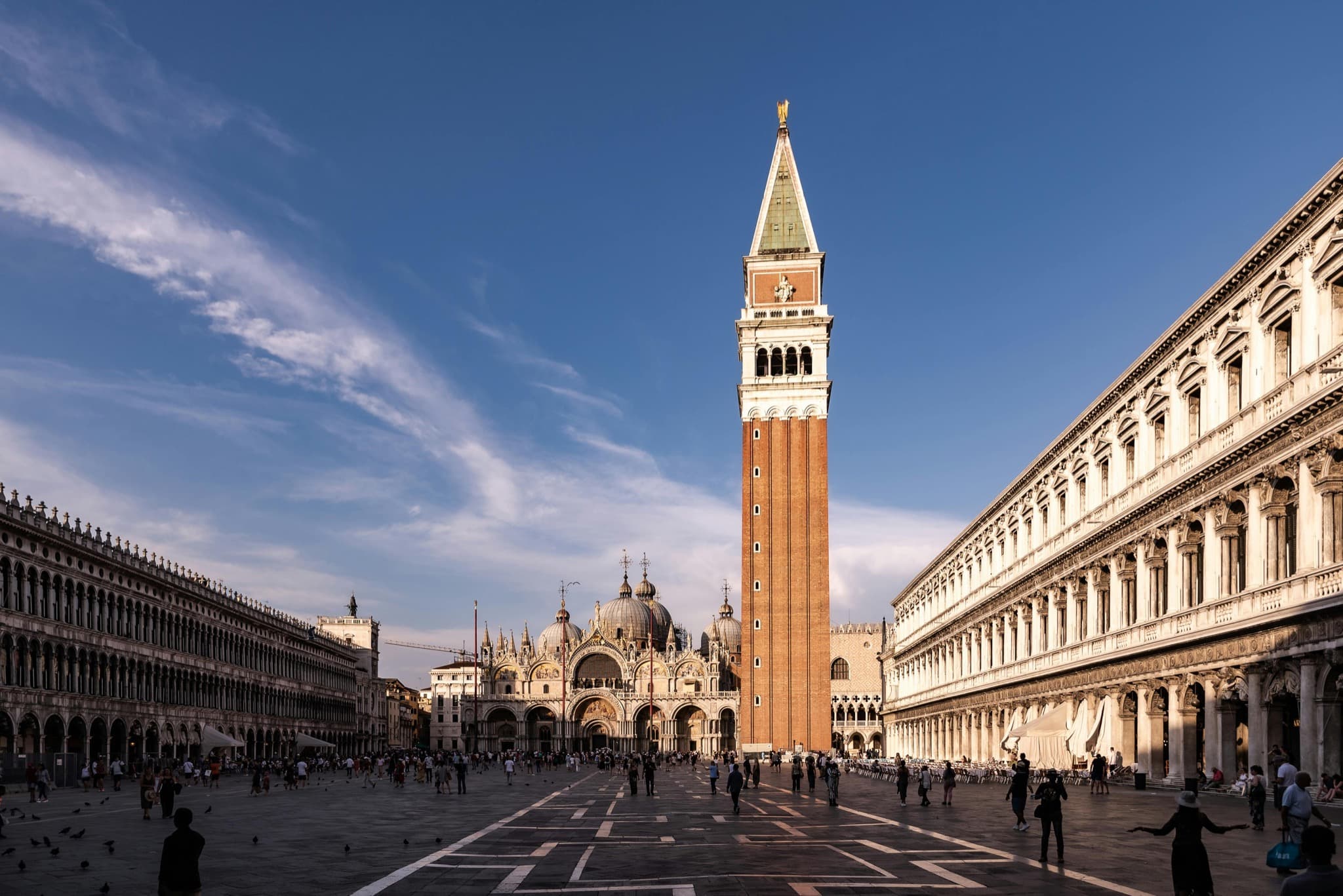
Day one is the stage where the Republic showed itself to the world: St Mark’s Square, St Mark’s Basilica, the Doge’s Palace, the Rialto Market. All packed into a few metres, as if the city had decided to gather its identity in one place. You start at the only square Venetians call a piazza — the rest, in Venice, are campi: a detail they repeat with pride that already marks the difference. St Mark’s wasn’t just another square. It was the square.
Suggested order:
- St Mark’s Square — the space where Venice represented itself to the world, opening toward the lagoon because power arrived and left by boat.
- St Mark’s Basilica — book your ticket to skip the queue. For nearly a thousand years it was the Doge’s chapel and the temple of the State: gold, mosaics and plunder from the Fourth Crusade of 1204.
- Doge’s Palace — the true political centre, seat of a control-obsessed government that chose not to look like a fortress. The Bridge of Sighs is crossed from inside it.
- St Mark’s Campanile — born as a watchtower to control who arrived by sea; in 1902 it collapsed entirely and was rebuilt.
- If you still have energy, walk to the Rialto Market — the city’s economic heart since 1097, long before St Mark’s became the political one.
Time: 6–8 hours with breaks. Walking: ~5 km.
Day 2 — the Grand Canal and Dorsoduro
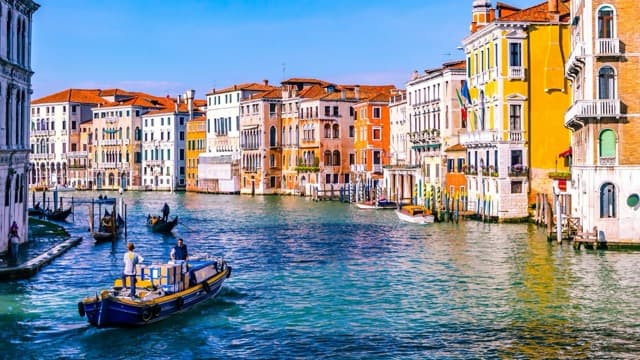
Day two is organised around the water. The Grand Canal crosses the city like an S-shaped avenue, 3.8 km lined with the palaces of the families who built their prestige facing the canal. You cross to Dorsoduro, the art sestiere, and you understand something: Venice also explains itself through paintings. Where Florence leaned on drawing, Venice leaned on colour, light and atmosphere — the very things the lagoon has.
Suggested order:
- Rialto Bridge — the first fixed crossing of the Grand Canal and, for centuries, the only one. The stone one you see (1591) replaced several wooden ones, one of which collapsed under the weight of a crowd.
- Grand Canal — walk its banks on foot or cross by vaporetto: over 170 palaces, one after another, each façade from a different era.
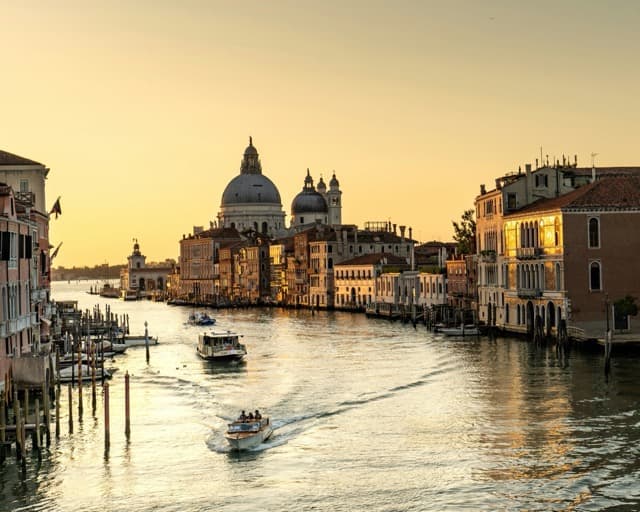
- Accademia Bridge — climb here to see Venice open up all at once: one of the widest views of the canal. The beloved wooden bridge was meant to be “temporary.”
- Gallerie dell'Accademia — centuries of Venetian painting (Bellini, Titian, Tintoretto, Veronese) and a Leonardo drawing that’s almost never on show.
- Close at Santa Maria della Salute, at the mouth of the canal — the great white mass Venice raised on a public vow after the plague of 1630. Nearby is Ca' Rezzonico if you want to see how the nobility lived.
Time: 6–8 hours. Walking: ~6 km.
Day 3 — the quiet sestieri
Day three you slow down and walk the Venice that works as a city, away from the set. To understand it, don’t just look at the canals: look at the bridges. The historic city is linked by over 400 — no one knows the exact number — and crossing it means climbing up and down almost all the time. It’s the day to get lost among the campi, watch Venice argue over its own identity and, if you’re up for it, reach the Arsenal, where its power began.
Suggested order:
- Scalzi Bridge — the first bridge many step on arriving, opposite Santa Lucia station. It doesn’t link two banks: it links two eras, the modern arrival and the historic fabric.
- Constitution Bridge — the Calatrava one, glass and steel, opened in 2008. It triggered something rare here: debate. Venice changes very little… but when it does, it shows.
- Teatro La Fenice — the phoenix: it burned twice and was reborn identical, “com'era, dov'era” (as it was, where it was). Rigoletto and La Traviata premiered here.
- Venetian Arsenal — the shipyard where the city turned wood and iron into naval power. At its peak it could assemble a ship in a single day: an assembly line centuries before Ford.
- Close by wandering the Canals of Venice, without a goal, leaping the small bridges that link the campi — the Venice that beats beneath the postcard.
Time: 5–7 hours. Walking: ~5 km.
What to avoid
- Eating right on St Mark’s Square or Rialto. Many spots on the most photographed points prioritise location over the kitchen and tend to charge more. Walk a few blocks inland, into Dorsoduro or Cannaregio, and you eat better.
- The perfect gondolas and midday selfies. If you want to see Venice without its costume, come early: before the crowds, especially at Rialto, the city still works as a city.
- Rushing St Mark’s Basilica. Over 8,000 square metres of gold mosaics built to dazzle. Rush it and you don’t understand anything.
- Trusting a wheeled stroller. Venice means climbing up and down bridges constantly. With kids, a baby carrier is better.
How to get around
Venice’s historic centre is small and walkable, but unlike any other city: there are no cars and no metro. The three routes in this guide are on foot from start to finish, leaping bridges. The city was built island by island, so walking means climbing up and down steps almost all the time.
Public transport is the vaporetto, the water-bus that runs the Grand Canal and connects to the islands. For this route you’ll use it little: maybe the Grand Canal once, or arrival and departure from the station. If you plan to move around by water a lot, an hourly or daily pass is worth it. But day to day, feet are the only real transport. Make sure you have comfortable, flat shoes.
If you ever need precise directions, one tap in Ruthy opens Google Maps, Apple Maps or Waze. The app is built for walking, not for turn-by-turn navigation.
Practical info
- Best time: April–June and September–October. July and August are hot and crowded; between autumn and winter the acqua alta can appear, the high tide that floods the lowest areas.
- St Mark’s Basilica tickets: book online at basilicasanmarco.it, saves the queue.
- Doge’s Palace: book online at palazzoducale.visitmuve.it. The Bridge of Sighs is crossed from inside.
- Where to stay: San Marco leaves everything on foot but pricier; Dorsoduro and Cannaregio are quieter with local life. Near Santa Lucia you have the train arrival close by.
- Gear: comfortable, flat shoes for the bridges. Reusable water bottle — there are public fountains around the campi. If you go in acqua alta season, add rubber boots.