Itinerary at a glance
How to think about Pisa in a day
You know Pisa for its tower, but its real story is one of loss. It was born an Etruscan and Roman port, became one of the great maritime republics of the Mediterranean, and built the Campo dei Miracoli with the spoils of its naval victories. Then came defeat against Genoa and a river that slowly pushed the coastline away. Pisa didn’t lose the sea — the sea pulled away from Pisa.
That changes how you walk it. The premise of this route is simple: the morning at the Campo dei Miracoli, the afternoon in the centre and along the Arno. All on foot. The historic centre is small and flat, and you cross it entirely in a relaxed day — there’s no need to rush.
This is one possible route, not the only one. Some people take the Tower photo and leave; others spend a whole hour watching the light shift on the marble. The compass points in a direction — you decide how long to stay at each stop. At each one, Ruthy tells you what you’re looking at standing right there, in no hurry.
Morning — the Campo dei Miracoli
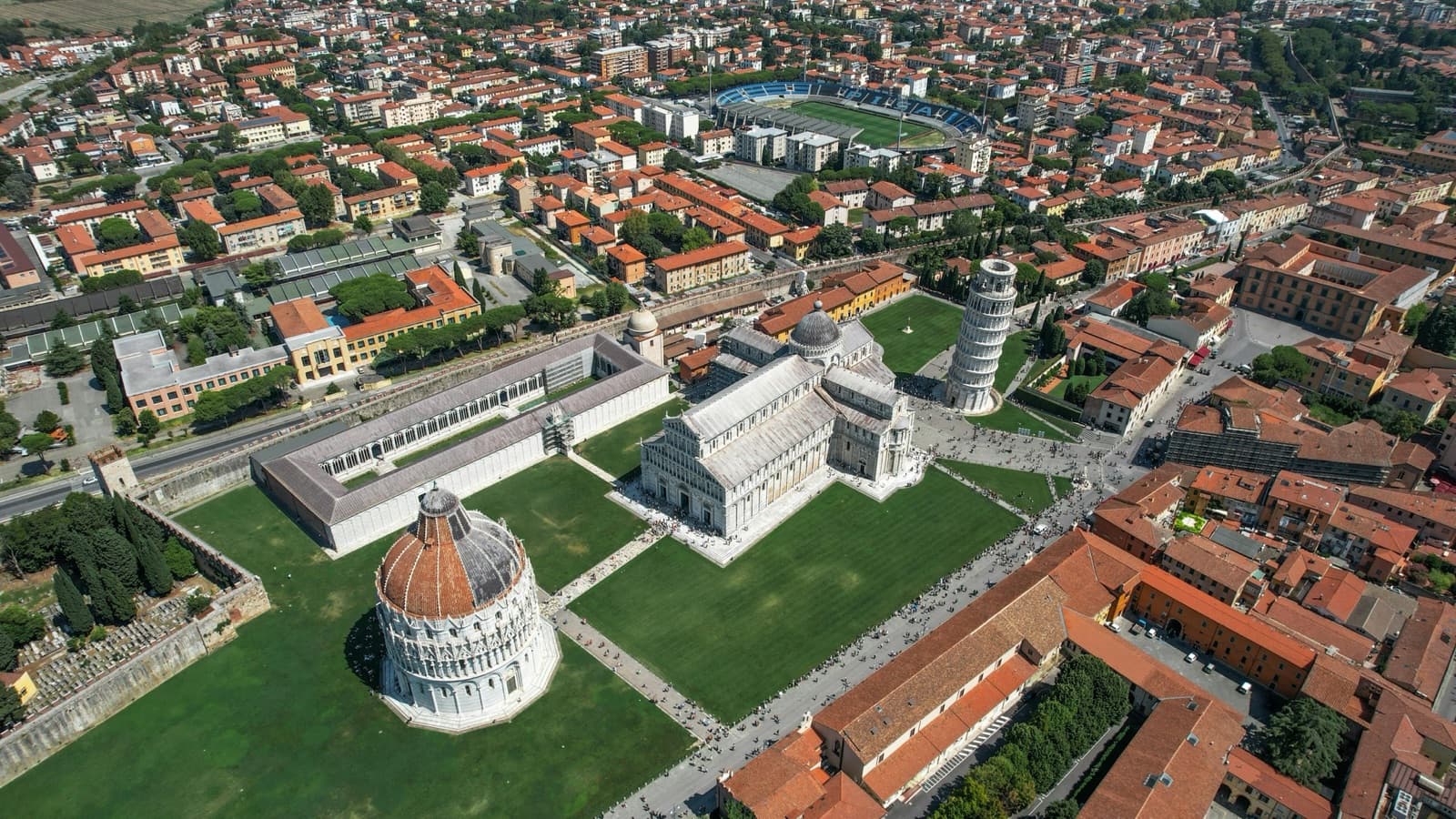
You start where Pisa chose to show itself to the world. The Campo dei Miracoli isn’t a square: it’s an idea turned to stone. Cathedral, Baptistery, Tower and Camposanto on an open lawn, meant to be read together — life, faith and death on a single axis. Much of the ensemble was raised between the 11th and 13th centuries, when Pisa ruled maritime routes and took part in the Crusades: the city didn’t store that wealth, it displayed it. Pisa didn’t raise an isolated temple; it raised a stage.
Suggested order:
- Porta Santa Maria — the threshold to the complex. First the narrow street, then the explosion of lawn and marble. The exact moment Pisa chose to show itself.
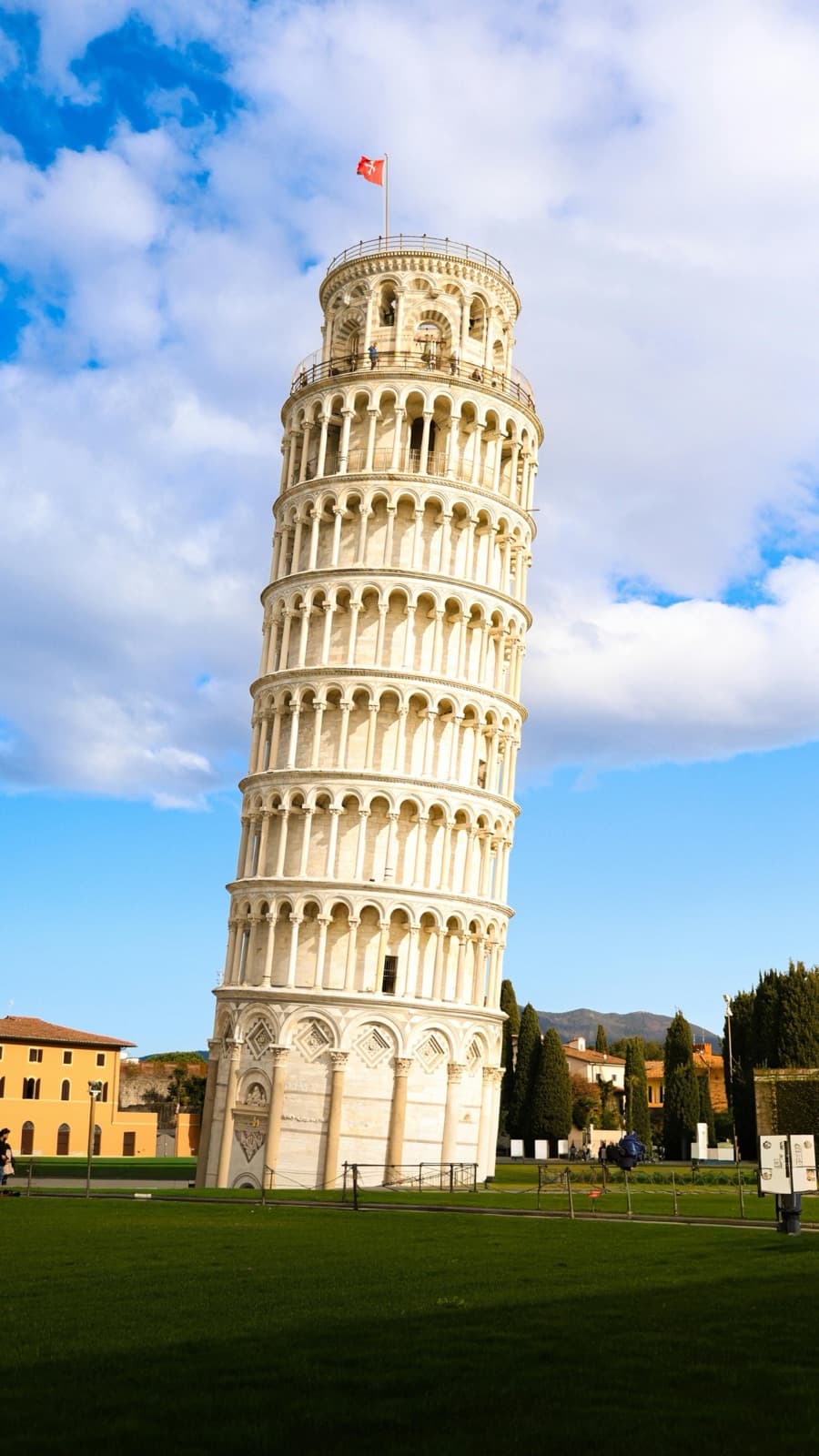
- Leaning Tower of Pisa — the bell tower that started tilting while it was still being built: the problem wasn’t the tower, it was the soft ground. If you want to climb, book a time-slot ticket.
- Cathedral of Pisa (Duomo) — begun in 1063 with the spoils of a naval victory: the cathedral is, literally, a product of the sea. By tradition, it was watching a lamp swing in here that Galileo sensed something about the pendulum.
- Baptistery of Pisa — the largest in Italy. What’s most striking isn’t seen, it’s heard: the space was built to resonate.
- Camposanto Monumentale — a marble cloister raised, by tradition, on soil brought from the Holy Land. An incendiary bomb in 1944 tore its frescoes from the walls.
- If you have time, the Museo dell'Opera del Duomo — here are the original sculptures of the complex, replaced outside by copies. It gives you the key to read everything else.
Time: 3–4 hours with the Tower climb. Walking: ~1.5 km within the complex.
Afternoon — the centre and the Arno
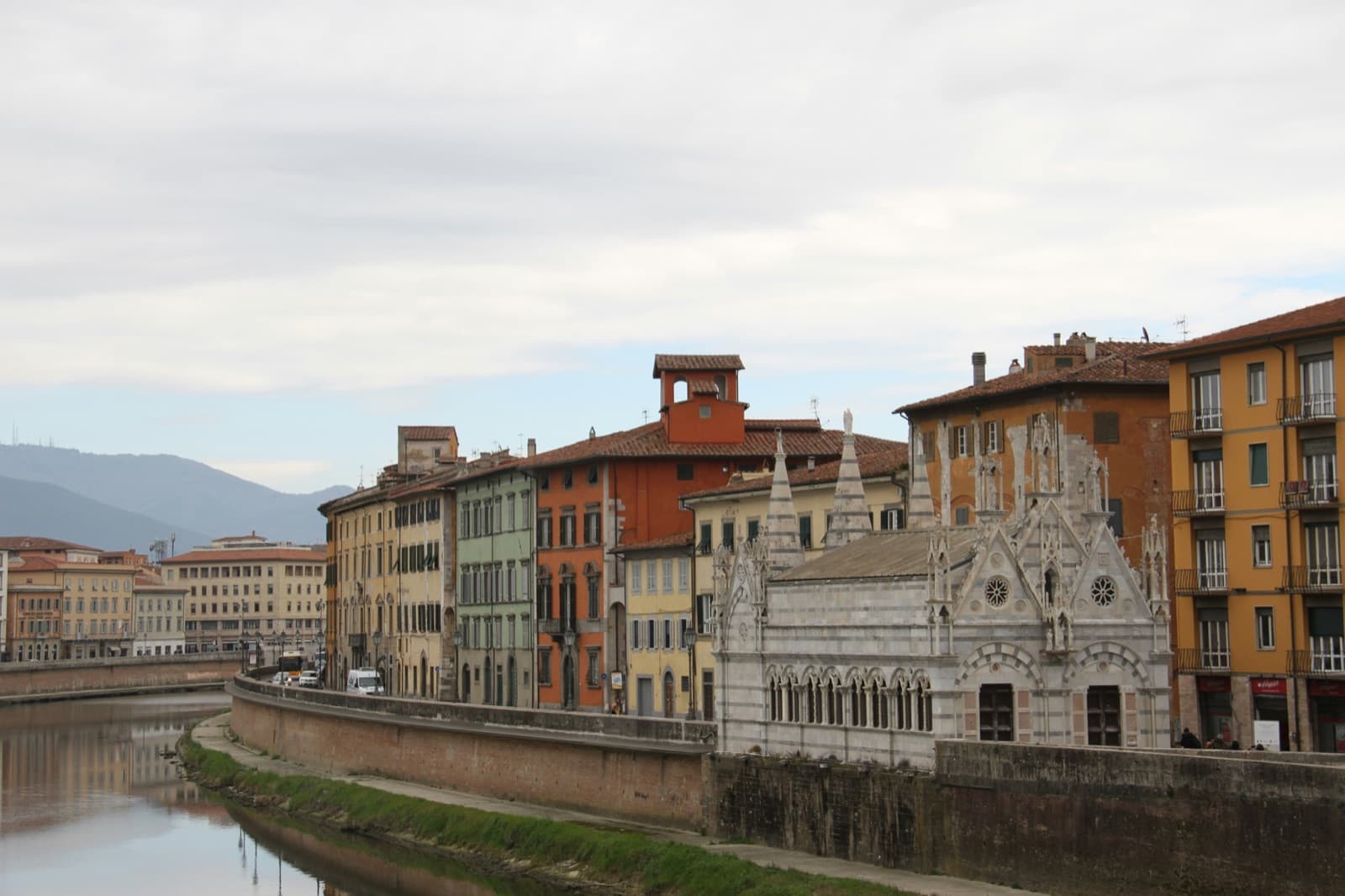
You leave the religious marble and change worlds. The afternoon is the Pisa that decided, and later the Pisa that found centrality again when it lost its maritime power: from trade to knowledge, from ships to ideas. You walk toward the centre and down to the Arno, the river that first made the city great and then, slowly, stole its coastline.
Suggested order:
- Piazza dei Cavalieri — the republic’s political heart. Here Pisa didn’t pray, it decided. After the Florentine conquest, Cosimo I and Vasari redesigned it for an order of knights who hunted pirates.
- Palazzo della Carovana — the façade covered in sgraffito that Vasari redesigned for Cosimo I. Today it’s the Scuola Normale Superiore: from knights to students, always shaping elites.
- University of Pisa — from 1343, one of the oldest in Europe. Galileo studied and taught here. When Pisa lost the sea, it found another axis: knowledge.
- Santa Maria della Spina — a jewel of Pisan Gothic at the river’s edge, which once held, by tradition, a thorn from Christ’s crown.
- Close by walking the lungarni along the Arno, with a stop at Palazzo Blu — that deep blue turns a 14th-century palace into a landmark within the city.
Time: 3–4 hours with breaks. Walking: ~3 km.
What to avoid
- Taking only the Tower photo and leaving. The Tower is the bell tower of an ensemble meant to be read as a whole. Staying inside the postcard means missing why the city built it.
- Eating right by the Campo dei Miracoli. Many spots beside the most photographed square prioritise location over the kitchen. Walk toward the centre or the lungarni and you eat better.
- Reaching the Tower without a ticket and hoping to climb. The climb is by time slot with limited capacity: if you didn’t book online, there may be no space that day.
- Rushing the Campo. Cathedral, Baptistery and Camposanto were designed as one system. Rush them and you see four loose buildings instead of a story.
How to get around
Pisa’s historic centre is small, flat and walkable. This whole route is on foot from start to finish: from the Campo dei Miracoli to Piazza dei Cavalieri and on to the Arno, you cross it entirely on foot, with no need for transport. In a relaxed day you cover 4 to 5 km in total.
From Florence, the regional train drops you in Pisa in about an hour (connections every 30 minutes). From the station to the Campo dei Miracoli it’s a comfortable walk that already pulls you into the city — or a couple of bus stops if you’re tight on time.
If you ever need precise directions, one tap in Ruthy opens Google Maps, Apple Maps or Waze. The app is built for walking and discovering, not for turn-by-turn navigation.
Practical info
- Best time: April–June and September–October. July and August are hot and the square fills up; winter is quieter and bright.
- Tower and Campo dei Miracoli tickets: book online at opapisa.it. The Tower is climbed by time slot with limited capacity; Cathedral, Baptistery, Camposanto and Museo dell'Opera share a combined ticket.
- Getting there: regional train from Florence, about an hour (Trenitalia, connections every 30 minutes). Doable as a day trip; staying overnight gives you the Campo at sunrise.
- Where to stay: the historic centre leaves you on foot from everything. Near the Arno or between the station and the Campo dei Miracoli are comfortable areas for a night.
- Gear: real walking shoes — you’ll cover 4–5 km and, if you climb the Tower, many steps on a tilted floor. Reusable water bottle.