Itinerary at a glance
How to think about Milan in 3 days
Milan presents itself to the world with shop windows, design and financial rhythm. But beneath that skin is a city that became capital of the Western Roman Empire — for a moment, more important than Rome. Here the Edict that freed Christianity was agreed, Leonardo painted the Last Supper, and in a discreet square fascism was born. In three days you won’t see all of it, and that’s fine. This route doesn’t aim for complete: it aims for coherent.
The premise is simple: day 1, the Duomo’s heart. Day 2, the Sforza and Leonardo. Day 3, the less obvious Milan — the Roman city and the canals. All on foot. The centre is flat and compact, and distances are short — there’s no need to rush.
This is one possible route, not the only one. Some people start with the Last Supper, others spend a whole afternoon under the Galleria’s dome. The compass points in a direction — you decide how long to stay at each stop. You don’t walk Milan looking for a postcard, but to understand layers working together. At each one, Ruthy tells you standing right there, in no hurry.
Day 1 — the Duomo’s heart
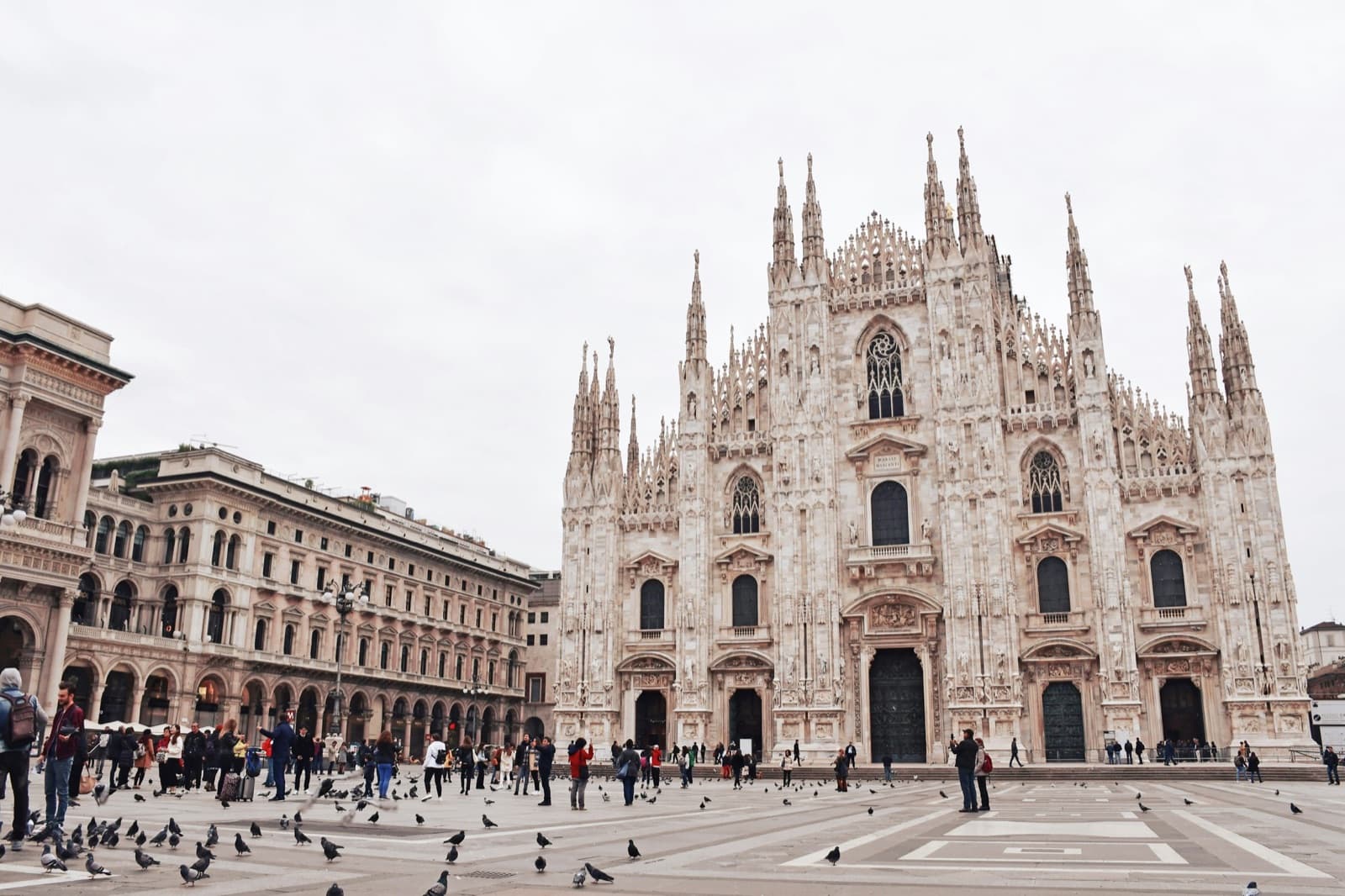
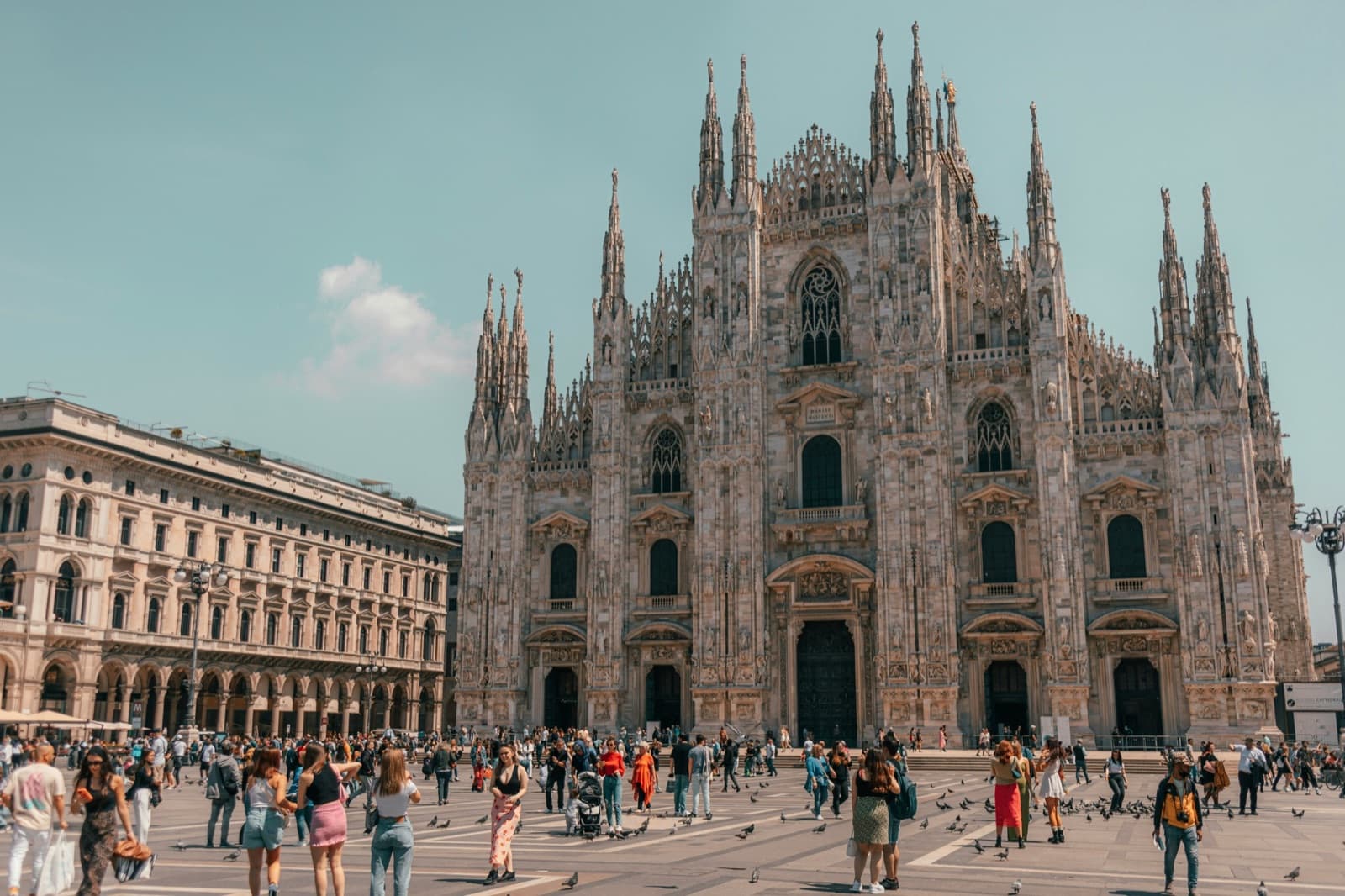
Day one is the nerve centre of the city: Duomo, Galleria Vittorio Emanuele II, Teatro alla Scala, Piazza dei Mercanti. Everything adjacent, a few steps apart. You start at the Duomo, a work begun in 1386 and only declared finished in 1965 — almost six centuries. No generation saw it complete: each inherited a piece. On top, gilded, the Madonnina, which for centuries marked the highest point in Milan.
Suggested order:
- Duomo di Milano — book online to skip the queue. Over 3,400 statues and a forest of pink marble that multiplies the closer you get.
- Duomo rooftops — go up to walk among the spires. One of the best viewpoints in the city; on clear days you can see the Alps.
- Galleria Vittorio Emanuele II — the “drawing room of Milan,” one of the oldest covered shopping arcades in the world. Its architect fell to his death from the works days before the opening.
- Teatro alla Scala — at the end of the Galleria. Plain on the outside, a horseshoe of legendary acoustics within; its audience doesn’t applaud out of courtesy, it judges.
- Piazza dei Mercanti — the medieval heart, before the great Duomo square existed. Try something under the arches of the Palazzo della Ragione: at certain points the sound amplifies on its own.
Time: 5–7 hours with breaks. Walking: ~5 km.
Day 2 — the Sforza and Leonardo
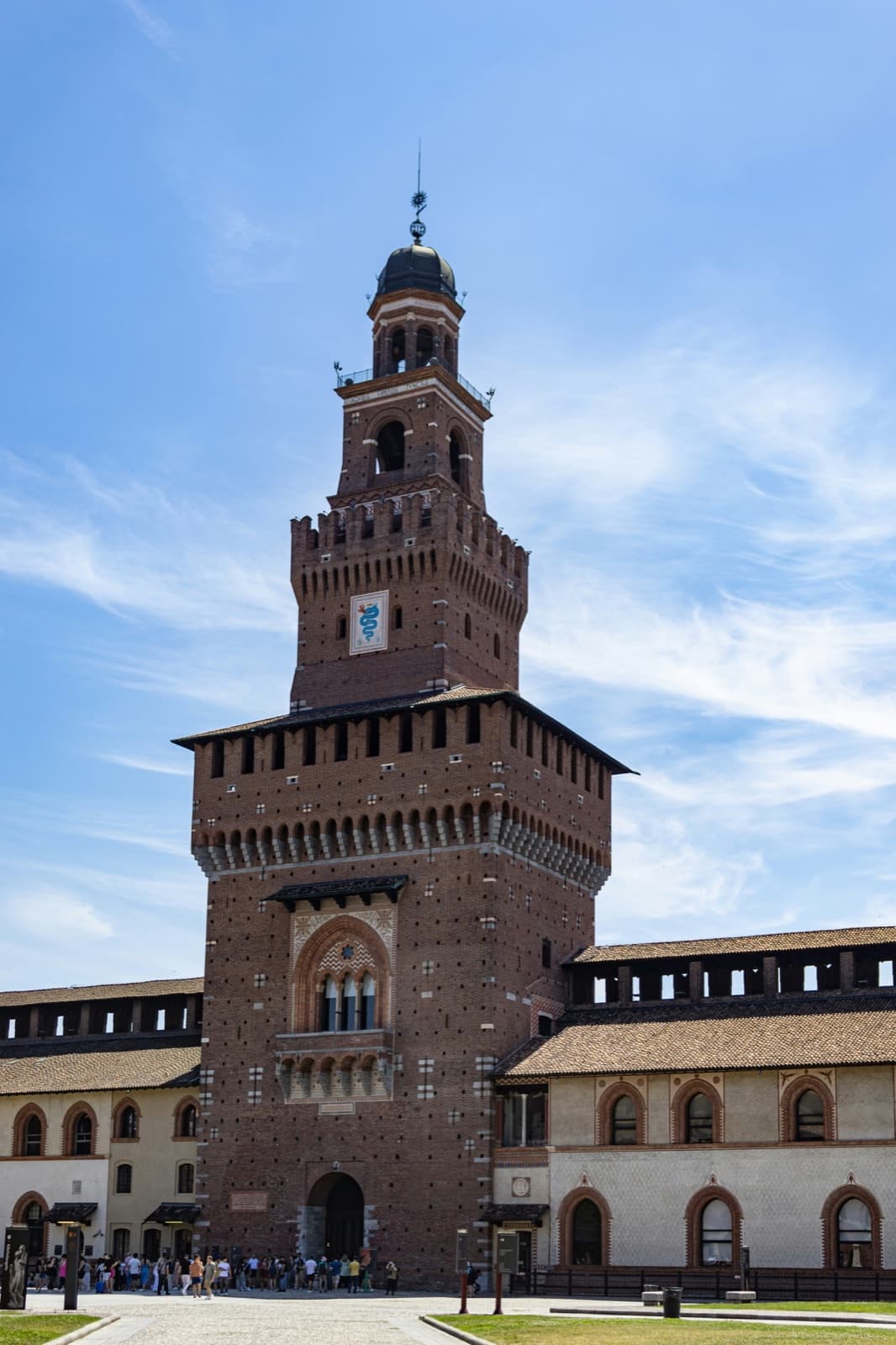
Day two is Renaissance Milan and ducal power. You begin at the Castello Sforzesco, a political machine made of stone that the Visconti raised and Sforza enlarged after seizing the city by force. Behind it opens Parco Sempione, where for centuries there was military ground. And, crossing the centre, Leonardo’s highest mark in Milan: the Last Supper, in Santa Maria delle Grazie.
Suggested order:
- Castello Sforzesco — walk it courtyard by courtyard: from the military Cortile delle Armi to the residential Cortile Ducale. For centuries the Milanese looked at it with admiration… and distrust.
- Pietà Rondanini, inside the castle — Michelangelo’s last sculpture, which he kept carving days before dying at 88. Unfinished, in endless revision.
- Parco Sempione — the city’s breathing space. It closes on a perfect axis: castle, greenery and the Arco della Pace at the far end, a Napoleonic arch the Austrians finished… dedicating it to peace.
- Santa Maria delle Grazie — a Dominican church and convent that Ludovico Sforza conceived as his dynasty’s mausoleum, with Bramante redesigning the apse. A 1943 bomb destroyed part of the convent.
- The Last Supper — entry by reservation only (see below). Leonardo painted the second after “one of you will betray me”: a shock wave of gestures and glances.
Time: 6–8 hours. Walking: ~6 km.
Day 3 — the less obvious Milan
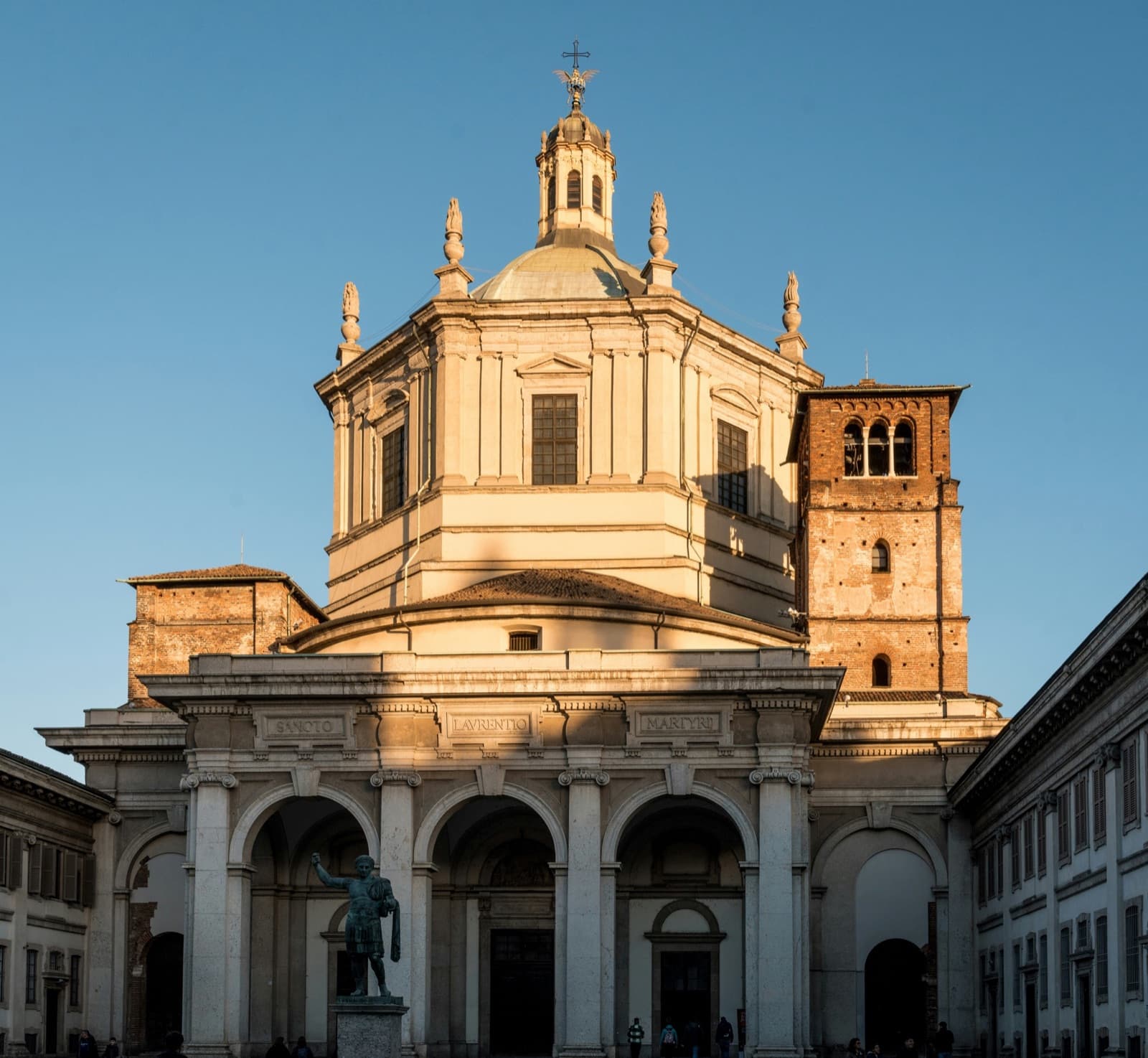
Day three you go down to the deepest layers: Roman and early-Christian Milan, and the city that lived off water. San Lorenzo Maggiore, with its sixteen reused 2nd-century Roman columns; the Basilica of Sant'Ambrogio, founded in the 4th century by the bishop who dared to stand up to emperors. And, to the south, the Navigli: a network of artificial canals that for centuries moved goods — even the marble for the Duomo.
Suggested order:
- San Lorenzo Maggiore — one of Milan’s oldest layers, out in the open. Its circular plan breaks with the usual; the Roman columns in front are testimony.
- Basilica of Sant'Ambrogio — Lombard Romanesque at its purest, with an atrium for those not yet allowed inside. Beneath the altar, the remains of St. Ambrose.
- Pinacoteca di Brera — Napoleon concentrated works from churches and convents here, because art is power too. Mantegna’s “Dead Christ” and Raphael’s “Marriage of the Virgin” are here.
- Navigli — get there for sunset, that’s the moment. Milan isn’t on the sea, and yet for centuries it lived off water; Leonardo studied its locks.
- If you still have energy, look in on Piazza San Sepolcro — discreet, far from the Duomo’s monumentality, and yet here an idea became a regime. Great changes don’t always begin in the most visible places.
Time: 5–7 hours. Walking: ~6 km.
What to avoid
- Eating right on Piazza del Duomo or inside the Galleria. Many spots at the most photographed points prioritise location over the kitchen and tend to charge more. Walk a few blocks into Brera or the Navigli and you eat better.
- Leaving the Last Supper to the last minute. Tickets sell out weeks, sometimes months, ahead. It’s the first thing to book when planning the trip, not something to improvise in Milan.
- Rushing the Duomo rooftops or Brera. The rooftops ask for time to walk among the spires; Brera, half a day if you want to understand what you see. Rush it and you don’t understand anything.
- Reaching the Navigli at midday. The moment is sunset, with the light on the water. Plan the day to be there at that hour.
How to get around
Milan’s historic centre is small, flat and walkable. The three routes in this guide are on foot from start to finish. The Duomo–Galleria–Castello–Sant'Ambrogio ring is crossed entirely on foot, with no need for transport.
Milan’s metro has five lines (M1 to M5) and solves the longer stretches — getting to the Navigli or the Darsena (M2, Porta Genova), to the Cimitero Monumentale (M5), or if you’re staying far from the centre. But for this route, day to day, feet are the only real transport. Make sure you have comfortable shoes — you’ll cover 16–20 km over three days.
If you ever need precise directions, one tap in Ruthy opens Google Maps, Apple Maps or Waze. The app is built for walking, not for turn-by-turn navigation.
Practical info
- Best time: April–June and September–October. July and August are very hot and humid on the plain; January and February, cold and often foggy.
- NOTICE — Last Supper (Cenacolo): requires booking weeks, sometimes months, in advance. Fixed time slots and very limited capacity. Book on the official site cenacolovinciano.vivaticket.it.
- Duomo and rooftop tickets: book online at duomomilano.it. The lift ticket to the rooftops costs more; it saves the queue.
- Where to stay: the centre by the Duomo gives you walking access to almost everything. Brera and the Navigli are areas with more neighbourhood life, just as well connected.
- Gear: real walking shoes, not fashion sneakers. Reusable water bottle — there are public fountains (the “vedovelle”) around the centre and Milan’s tap water is drinkable.