Itinerary at a glance
How to think about Kansas City in a day
Kansas City was born from the river, at the edge of what the country knew of itself. Before the trains and the highways, the Missouri was the great artery of the interior, and this was the last big stop before the West. From that crossroads came something improbable: a capital of jazz and Negro Leagues baseball, right in the middle of the country. In a day you won’t see all of it, and that’s fine. This route doesn’t aim for complete: it aims for coherent.
The premise is simple: the morning for downtown and the WWI memorial. The afternoon for the jazz of 18th & Vine and the Plaza. In one day you cover downtown and 18th & Vine without rushing — as long as you accept that Kansas City is spread out, and that between zones you’ll move on more than your feet.
This is one possible route, not the only one. Some people start by the river, others spend a whole morning in a single museum. The compass points in a direction — you decide how long to stay at each stop. At each one, Ruthy tells you what you’re looking at standing right there, in no hurry.
Morning — downtown and the memorial
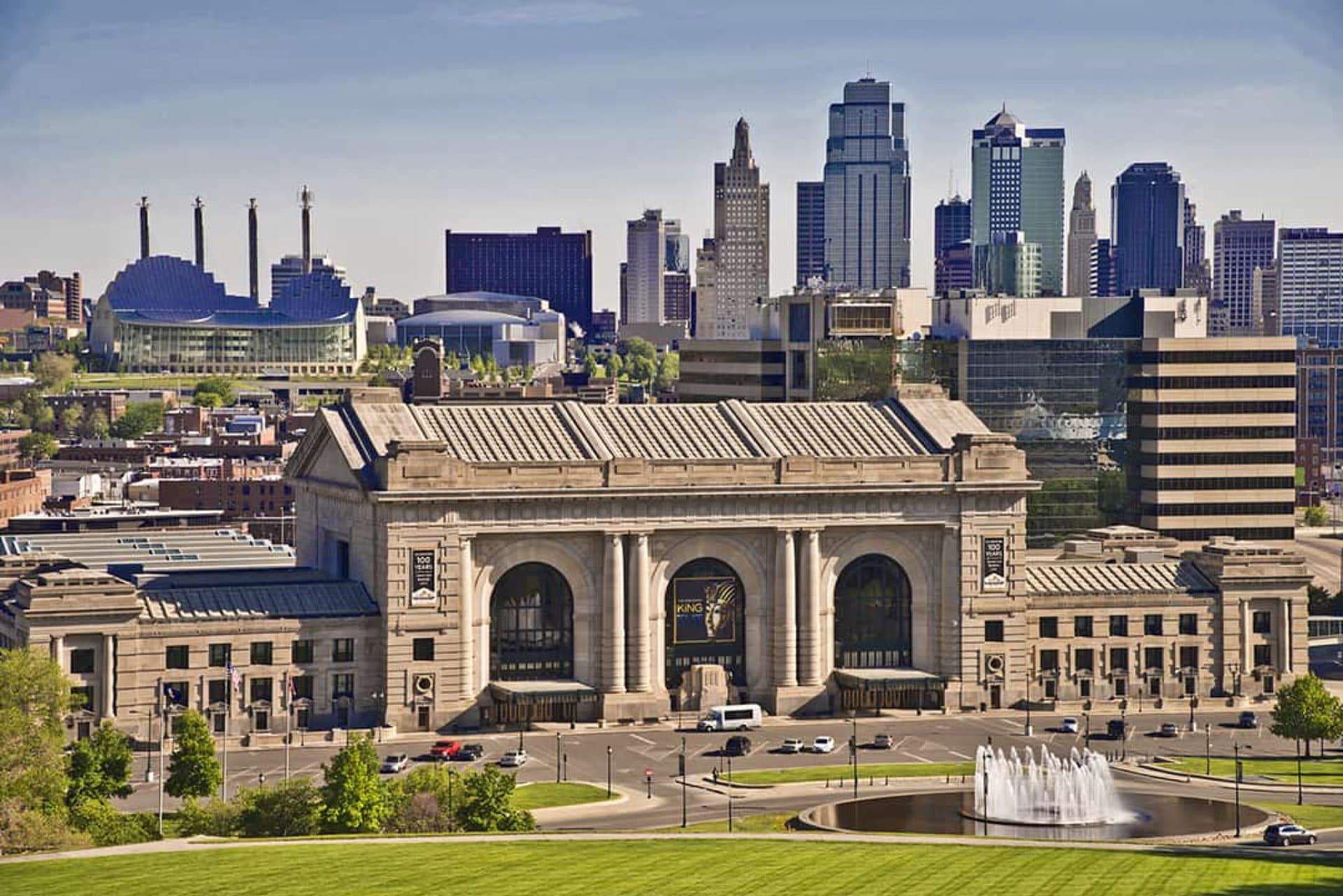
The morning is the Kansas City that announced itself to the country. You start at Union Station, opened in 1914: it looks more like a palace than a terminal, and that was exactly the point. In its best years over 200 trains passed through daily — a city within the city, the gateway to the West. A few steps away, on a hill overlooking downtown, a stone tower that works almost like a lighthouse: the WWI memorial.
Suggested order:
- Union Station — the symbol of railroad Kansas City, now a cultural space and science center. Look up at the Grand Hall ceiling.
- National WWI Museum and Memorial (Liberty Memorial) — the United States’ main national memorial to World War I. From the tower, one of the best views of the city.
- Kansas City City Hall — an Art Deco silhouette from 1937, from when the city stopped thinking of itself as a frontier town and started seeing a metropolis. For years, one of the tallest city halls in the world.
- If you have time, look in on the Jackson County Courthouse, on the same civic axis — Art Deco from 1934, geometry and verticality.
Time: 4–5 hours with breaks. Walking: ~3 km downtown.
Afternoon — jazz and the Plaza
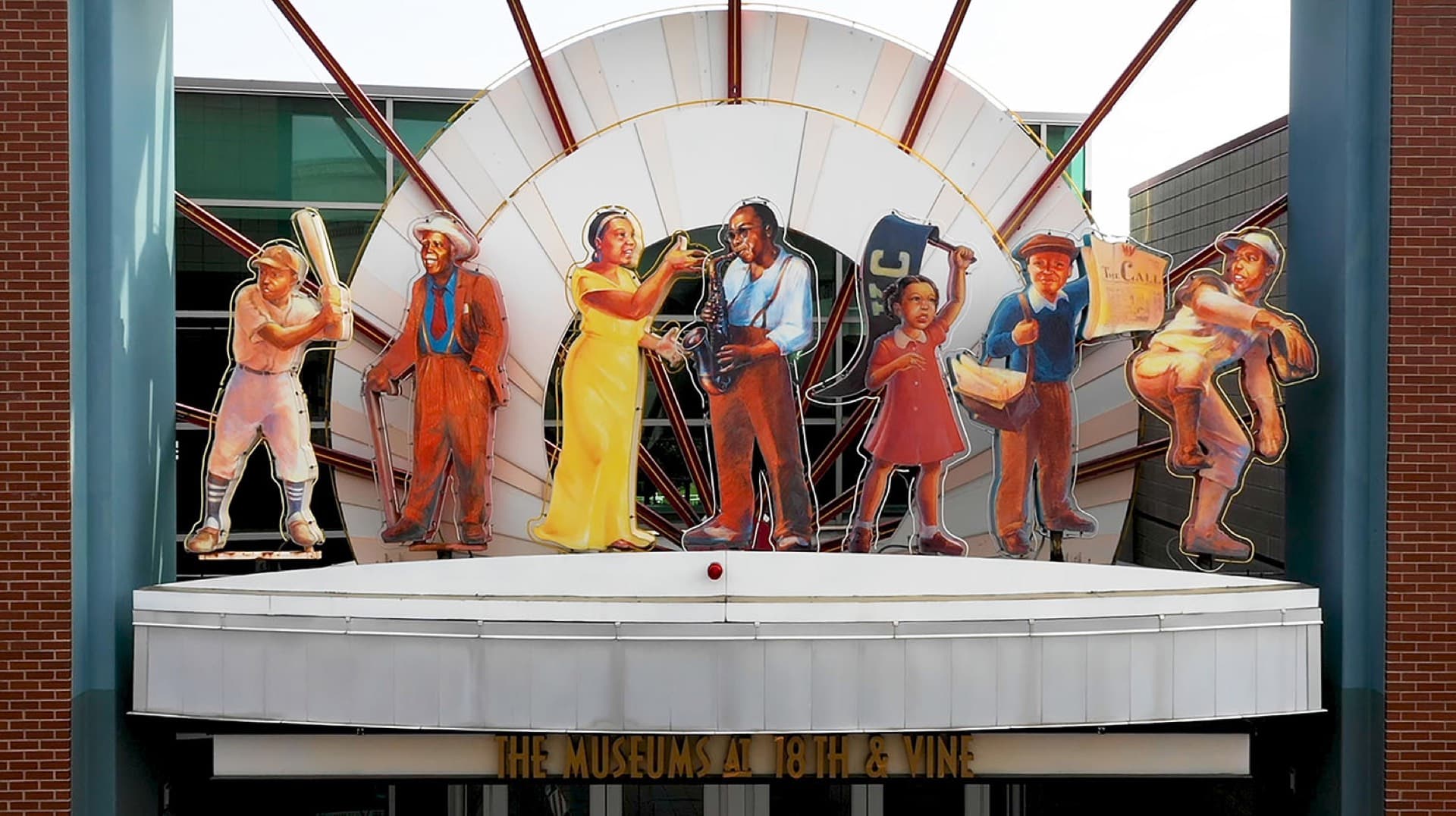
The afternoon is the city’s cultural heart. In historic 18th & Vine you understand why Kansas City matters so much in American music: in the 1920s and ’30s it was one of the great laboratories of jazz, with Count Basie and Charlie Parker coming out of these clubs. In the same neighbourhood the Negro Leagues were born, the Black baseball built against Major Leagues that excluded it. And to the south, another face of the city: a plaza imitating Seville.
Suggested order:
- American Jazz Museum — jazz not as a genre but as a way of living the city. Here the music kept going until dawn when other cities were closing.
- Negro Leagues Baseball Museum, next door — segregation, talent and resistance. In its full-size recreated field you walk among the sculptures, as in a game from the 1930s.
- Country Club Plaza — head south. A 1920s shopping district with towers and tiles imitating Seville, designed for the automobile age. Seville, reimagined in Missouri.
Time: 4–6 hours. Walking: ~2 km within each zone (not between zones).
What to avoid
- Walking between 18th & Vine, downtown and Country Club Plaza. They look close on the map, but the distances between zones are long. Save your feet for inside each neighbourhood and move by car, taxi or ride app between them.
- Rushing 18th & Vine. The American Jazz Museum and the Negro Leagues Baseball Museum complement each other and tell the same history from two angles. Rush them and you miss half.
- Squeezing the river and the Arabia Steamboat Museum into the same day. They’re extraordinary, but they add time and kilometres. If you have a single day, leave them for a future trip.
- Reaching the memorial without going up the tower. The panoramic view of downtown from the top is much of the experience. Allow for that time.
How to get around
Kansas City’s downtown is walkable and, on top of that, a free streetcar runs through the center connecting much of the zone: it solves the stretches along the central axis at no cost. Union Station, the WWI memorial and the City Hall are within comfortable walking distance.
But Kansas City is spread out, and this route crosses separate zones. 18th & Vine is a few minutes from downtown, and Country Club Plaza is well to the south. To hop from one to another, a car, taxi or ride app helps. Within each neighbourhood, though, your feet are the real transport.
If you ever need precise directions, one tap in Ruthy opens Google Maps, Apple Maps or Waze. The app is built for walking, not for turn-by-turn navigation.
Practical info
- Best time: April–June and September–October, the most comfortable for walking. The Midwest summer is hot and humid; winter is cold.
- December has its own plan: since 1930, every Christmas millions of lights decorate the towers and streets of Country Club Plaza, a tradition that remains one of the city’s great urban events.
- Two zones, two halves: keep downtown and the memorial for the morning, and 18th & Vine plus the Plaza for the afternoon. In between, transport.
- If you have a spare day: add the Kansas City Riverfront and the Arabia Steamboat Museum — a 19th-century steamboat buried for over a hundred years under a cornfield.
- Gear: real walking shoes. Reusable water bottle, especially in summer.