Itinerary at a glance
How to think about Florence in 3 days
Florence is a small city that changed the world without firing a shot. It was born a Roman camp, grew rich on banking and the florin, bled in family wars and ended up inventing the Renaissance. Behind every façade there’s a family —the Medici, the Pazzi—; behind every square, a conspiracy; behind every work, a political commission. In three days you won’t see all of it, and that’s fine. This route doesn’t aim for complete: it aims for coherent.
The premise is simple: day 1, the Duomo and the origin. Day 2, the power of the Medici and the art. Day 3, the David and the Oltrarno. All on foot. The centre is compact and pedestrian, and distances are short — there’s no need to rush.
This is one possible route, not the only one. Some people start with the Uffizi, others spend a whole morning in a single square. The compass points in a direction — you decide how long to stay at each stop. At each one, Ruthy tells you what you’re looking at standing right there, in no hurry.
Day 1 — the Duomo and the origin
Day one is the old heart of the city: the Duomo, the Baptistery of San Giovanni and Giotto’s Campanile. All on the same square. You start at the beginning — the first stone of the Duomo, also called Santa Maria del Fiore, was laid in 1296, and it was finished over 140 years later. One generation began it and four finished it. But what changed the history of architecture is at the very top: Filippo Brunelleschi’s dome, the first great dome built in the West since antiquity, raised without wooden scaffolding holding it up from below. Here the spark of the Renaissance was lit.
Suggested order:
- Baptistery of San Giovanni — the oldest building in the centre. Its gilded bronze doors took Ghiberti nearly 27 years; what you see are replicas, the originals are kept safe.
- Duomo (Santa Maria del Fiore) — entry to the cathedral is free, but the queue is long. Inside, above your head, Vasari and Zuccari’s Last Judgement fresco.
- The Brunelleschi dome — if you want to climb, book a date and time in advance: the slots fly. At the top, one of the best views of the city.
- Giotto’s Campanile — Giotto began it in 1334 and died without seeing it finished. Climb the 414 steps and you come face to face with the dome.
- If you still have energy, walk around the Duomo to the copper ball mark — the disc marking where the dome’s gilded sphere fell after a lightning strike in 1600.
Time: 5–7 hours with breaks. Walking: ~4 km.
Day 2 — Medici power and the art
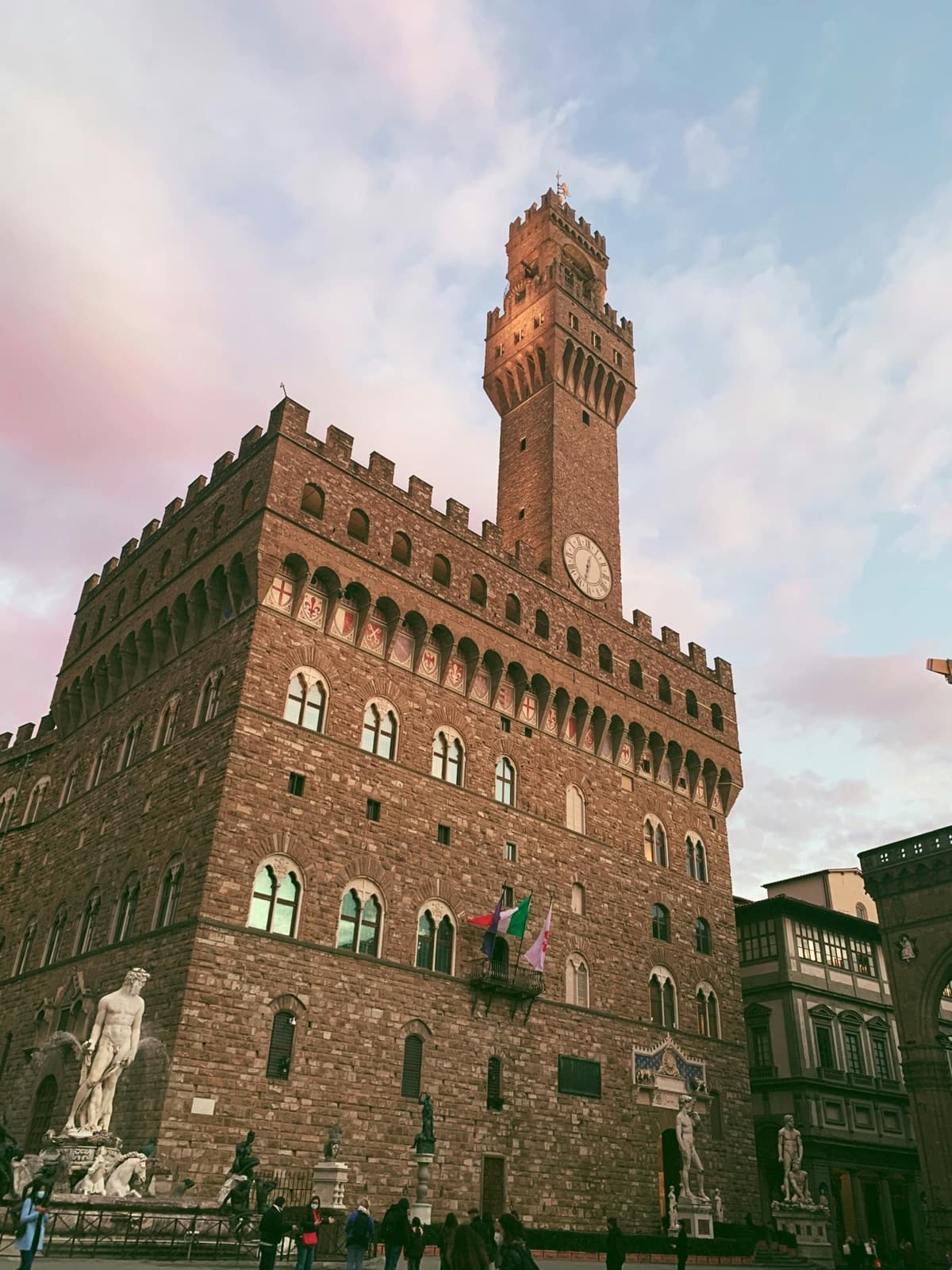
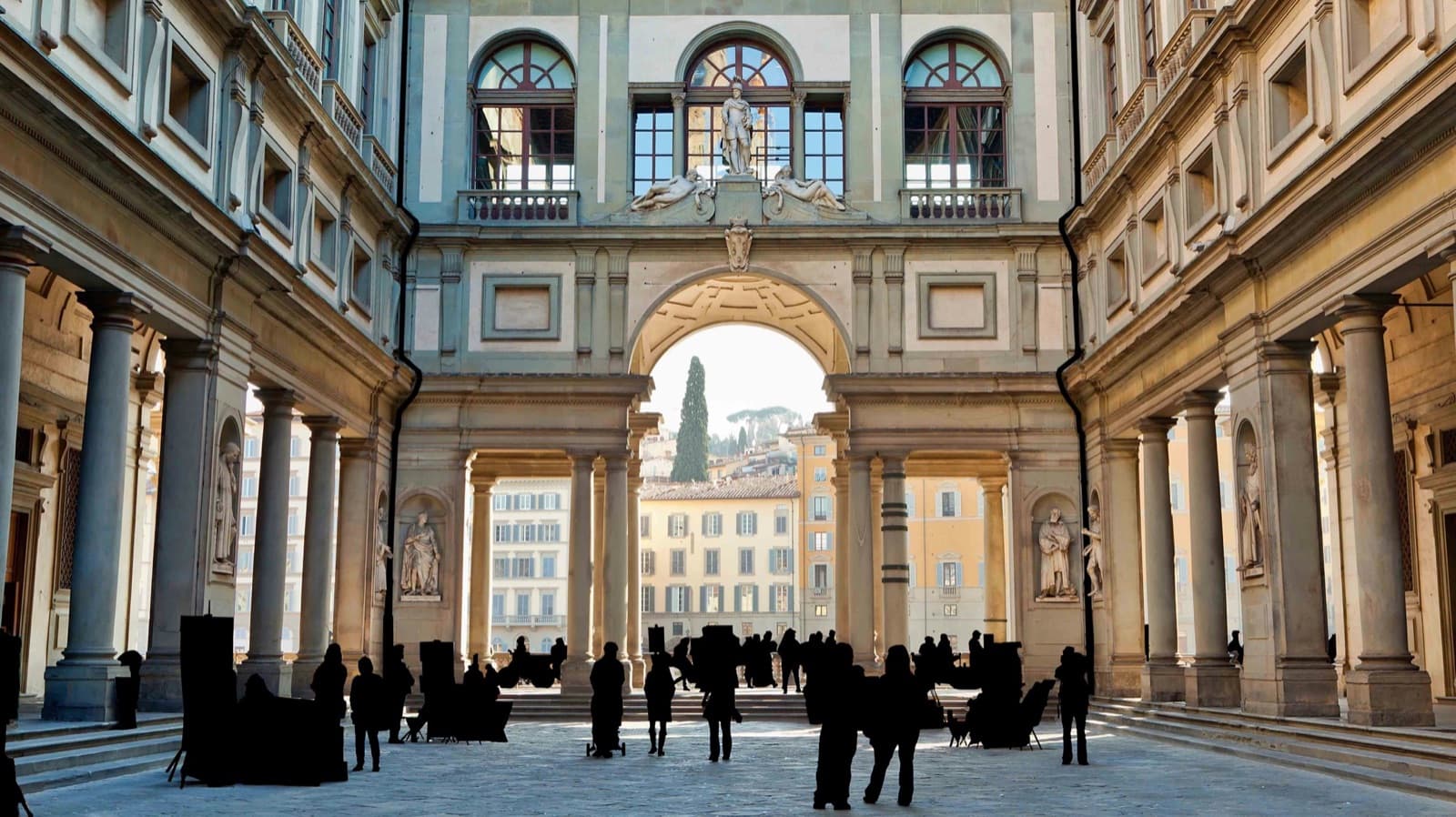
Day two is the Florence of power: that of the Medici, who turned art into a tool of government. You walk from the political heart of the city to the museum that began as their offices. Piazza della Signoria was the stage of glories and tragedies: here the republic governed and then the Medici, here the Pazzi conspirators were hanged, here a friar was burned in 1498. A few steps away, the Uffizi —which in Italian means, precisely, “offices”— hold the visual biography of Florence. You close by crossing the Ponte Vecchio.
Suggested order:
- Piazza della Signoria and Palazzo Vecchio — a roofless museum: the Loggia dei Lanzi with Cellini’s Perseus, the copy of the David, Ammannati’s Neptune. Every stone hides a secret.
- The ball mark — a disc on the paving marks where the friar Savonarola was executed, the same man who had lit the “bonfire of the vanities”.
- Michelangelo’s “Importuno” — look, a metre and a half off the ground on a corner of the Palazzo Vecchio, for a profile carved into the stone. In Florence, even the stones laugh.
- Uffizi Gallery — book online with a date and time. Botticelli, Leonardo, Caravaggio: plan for half a day done properly.
- Ponte Vecchio — the oldest bridge in Florence, lined with shops since 1345. It survived floods and the Nazi retreat of 1944, when every other bridge was blown up.
Time: 6–8 hours. Walking: ~4 km.
Day 3 — the David and the Oltrarno
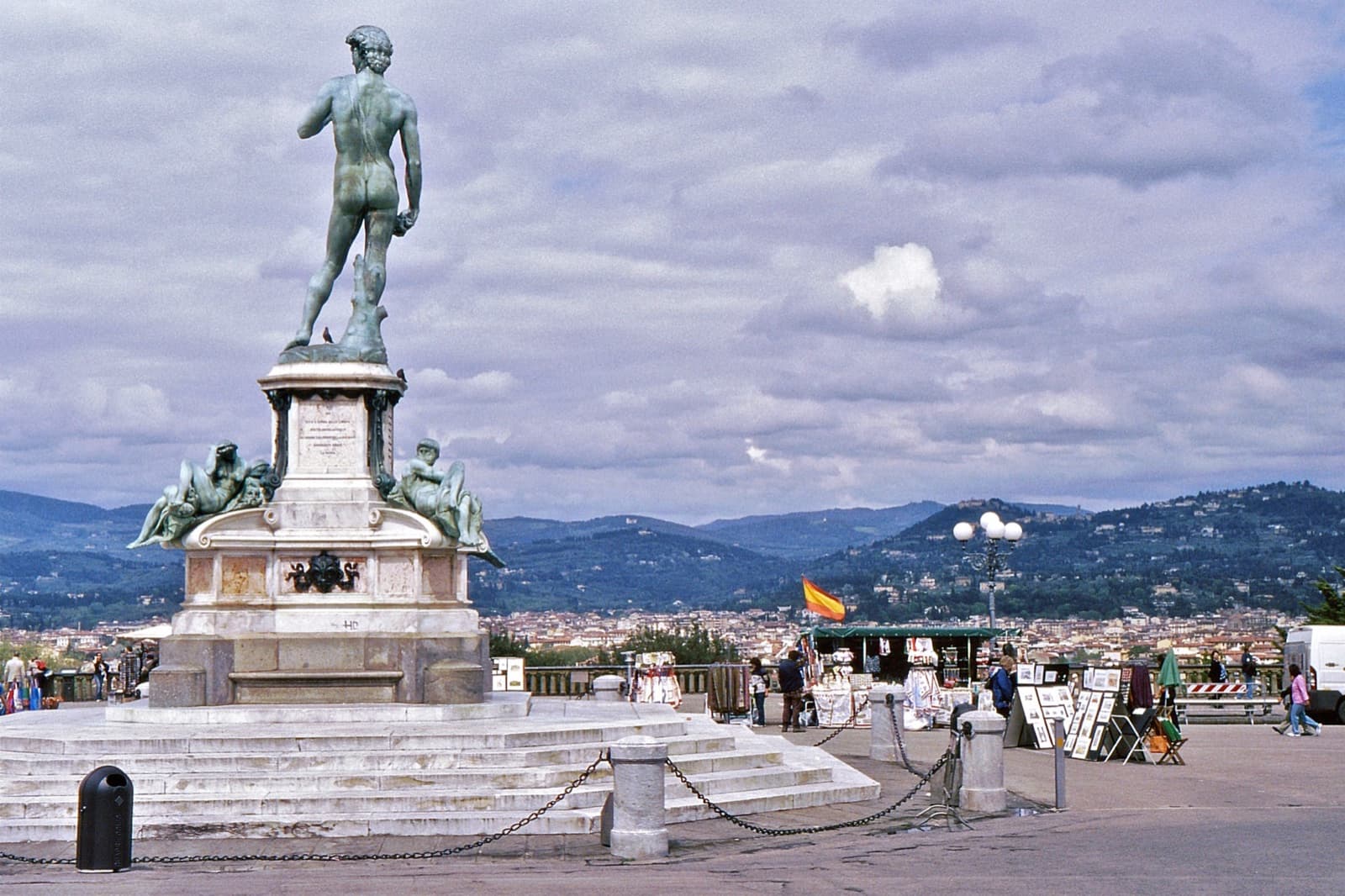
Day three starts with the absolute star and then crosses the river. Galleria dell’Accademia: a museum with a single star, but what a star. Michelangelo’s David, over five metres carved from one block of Carrara marble, captured in the doubt before the fight, not in the triumph. Then you cross into the Oltrarno, the other bank of the Arno: the Palazzo Pitti and the Boboli Gardens, the Medici’s private garden that was the model for Versailles. And you close by climbing to Piazzale Michelangelo for sunset.
Suggested order:
- Galleria dell’Accademia — book online. On the way to the David, the unfinished “Prisoners” seem to struggle out of the stone: for Michelangelo, the figure was already inside.
- Palazzo Pitti — banker Luca Pitti built it to outshine the Medici, and ended up selling it to them. It was home to three dynasties.
- Boboli Gardens — not made for resting, but for impressing. Terraces, theatrical grottoes, a Neptune fountain, even an Egyptian obelisk.
- Climb to Piazzale Michelangelo — get there for sunset, that’s the moment. A bronze replica of the David watches over the terrace.
- If you go in, close with the Basilica of Santa Croce — Italy’s “pantheon”: within a few metres of each other rest Michelangelo, Galileo, Machiavelli and Rossini.
Time: 6–8 hours. Walking: ~6 km.
What to avoid
- Reaching the Uffizi or the Accademia without a booking. They’re among the most visited museums in Italy: without a dated, timed ticket the queue can eat your whole morning. Book online in advance.
- Eating right by the Duomo or Piazza della Signoria. Many spots on the most photographed squares prioritise location over the kitchen and tend to charge more. Walk a few blocks or cross into the Oltrarno and you eat better.
- Rushing the Uffizi. It’s one of the most important museums in the world: half a day minimum if you want to understand what you see. Rush it and you don’t understand anything.
- Reaching Piazzale Michelangelo at midday. The moment is sunset, when the sun turns the rooftops gold. Plan the day to be there at that hour.
How to get around
Florence’s historic centre is small, compact and almost all pedestrian. The three routes in this guide are on foot from start to finish. The Duomo–Piazza della Signoria–Uffizi–Ponte Vecchio ring is crossed entirely on foot, with no need for transport, and even the Oltrarno with the Palazzo Pitti is within walking distance.
The only stretch that’s hard on foot is the climb to Piazzale Michelangelo, on a hill across the Arno: you can walk it, but there are also city buses that drop you at the top. For the rest of the route, day to day, feet are the only real transport. Make sure you have comfortable shoes and watch the cobbles — you’ll cover 14–16 km over three days.
If you ever need precise directions, one tap in Ruthy opens Google Maps, Apple Maps or Waze. The app is built for walking, not for turn-by-turn navigation.
Practical info
- Best time: April–June and September–October. July and August are very hot and crowded in the centre; winter is quieter and bright.
- Uffizi Gallery tickets: book online at uffizi.it, with a date and time slot.
- Galleria dell’Accademia (the David): book online in advance, especially in high season.
- Duomo dome: the climb is by dated, timed booking with limited slots; it sells out days ahead. The cathedral itself is free to enter.
- Where to stay: the centre between the Duomo and the Signoria gives you walking access to almost everything; the Oltrarno, next to the Palazzo Pitti, offers a neighbourhood feel a step from the Ponte Vecchio.
- Gear: real walking shoes for the cobbles, not fashion sneakers. Reusable water bottle — there are public fountains around the centre.