How to plan the visit
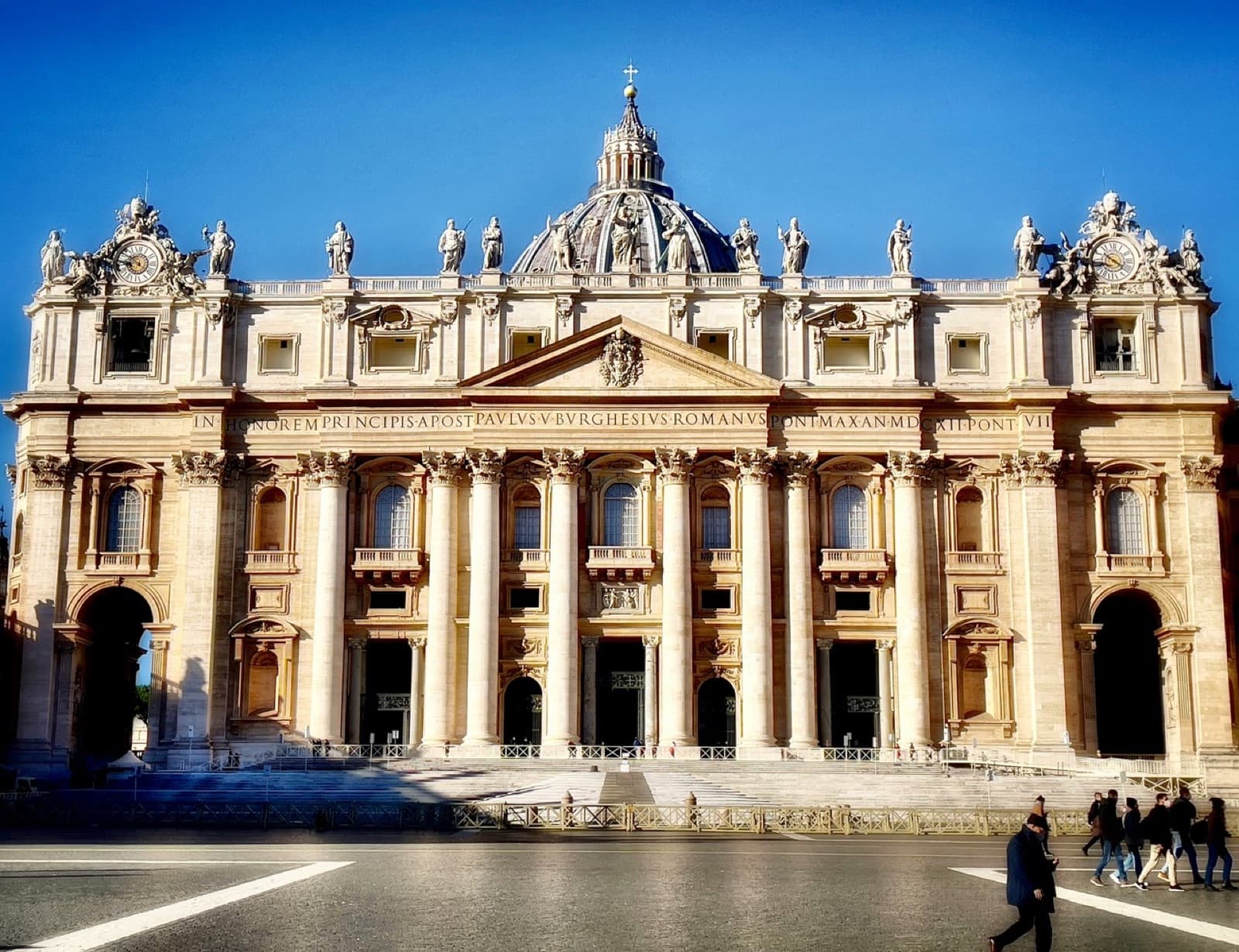
The Vatican is three different things glued together: a baroque square, a basilica that is the roof of Catholicism, and museums that gather two thousand years of papal art. It’s the smallest state in the world — 44 hectares — but you don’t understand it by its size, you understand it by what it represents. And all of it — square, basilica, museums — grew out of one thing: a tomb, that of the apostle Peter, buried here by tradition after his martyrdom in the 1st century. In half a day you can see all three, but you have to go in order and with tickets booked — without that, half your day disappears into queues.
This guide isn’t exhaustive — the Vatican Museums alone hold 70,000 pieces and 12 km of galleries. It’s a coherent visit proposal: it sequences the flow so you understand what you’re seeing and don’t reach the Sistine Chapel exhausted at the end, staring at the ceiling for two minutes before they move you on.
Before you go
- Book online entry to the Vatican Museums at museivaticani.va. Small extra cost, saves 2 hours of queueing.
- Arrive early — open Monday to Saturday 8:00–20:00 (last entry 18:00). The earlier you go in, the fewer people in the Sistine.
- Dress code: shoulders and knees covered, men and women. Otherwise you won’t be let in.
- Airport-style security at both Museum and Basilica entrances — check what’s in your backpack or bag; liquids and large luggage can slow you down or be turned away.
- Avoid Wednesday mornings — papal audience in the square, pilgrims everywhere.
St. Peter’s Square and the Colonnade
Before entering the basilica, stop in the middle of the square and let the space wrap around you. St. Peter’s Square was designed by Bernini between 1656 and 1667 for Alexander VII, at the height of the Counter-Reformation: the 284 columns in four rows aren’t decoration, they’re the “arms of the Church” embracing those who arrive — baroque theology turned into stone. At the centre, the Egyptian obelisk that Caligula brought to Rome in the 1st century, today a symbolic axis between the pagan past and the Christian present.
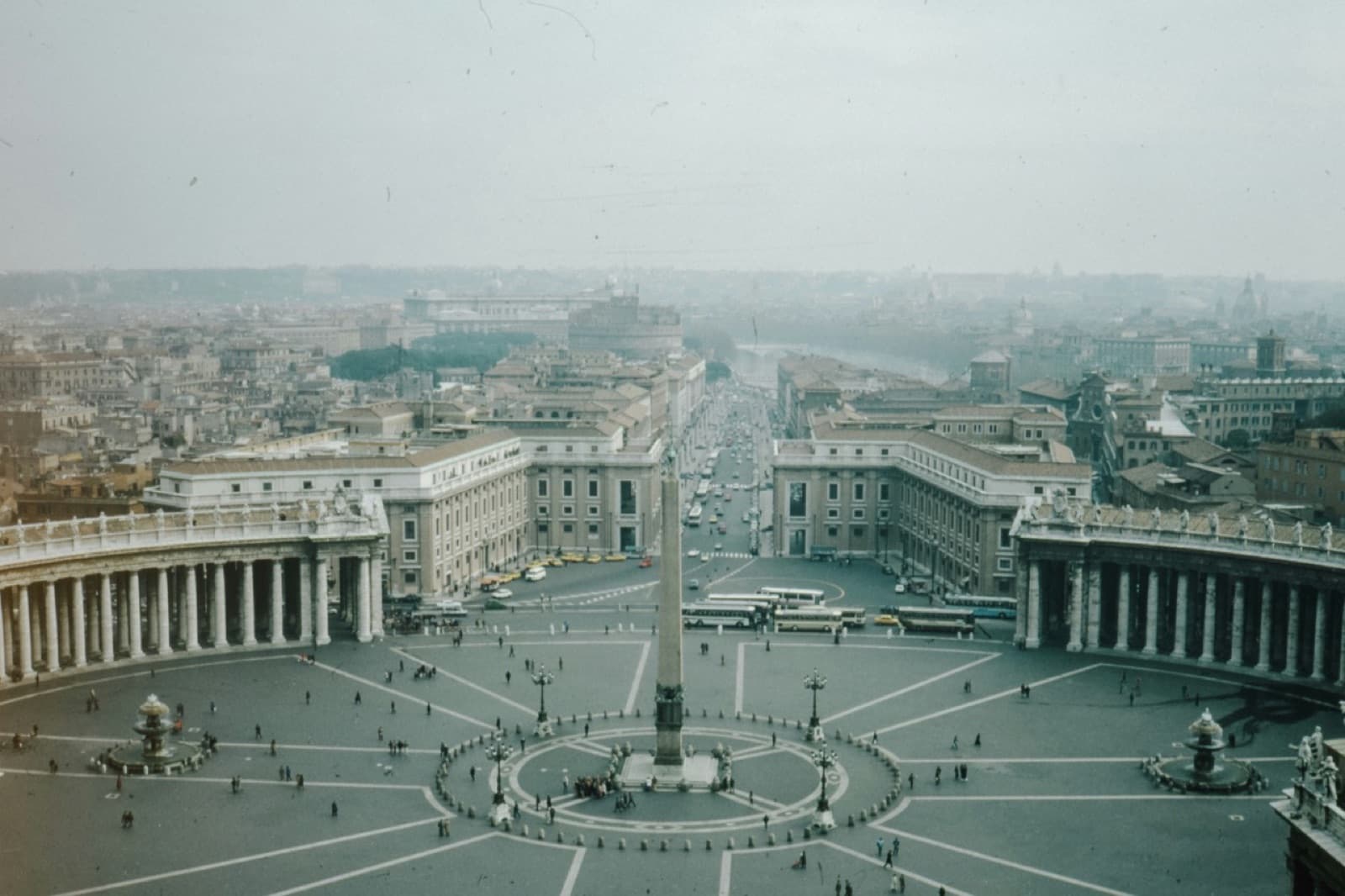
If you have time, walk to the centre of the square and look at the two marble discs on the floor (one on each side of the obelisk): standing on them, the four rows of colonnade align perfectly into a single line. It’s Bernini’s baroque visual trick.
Vatican Museums
The entrance is on the north side of the Vatican (blocks north of the Basilica). The typical tourist route tends to lead you to the Sistine Chapel at the end, though there are variants and optional rooms you can mix in depending on your interest and time.
Don’t-miss along the way:
- Gallery of Maps — a 120 m corridor with 16th-century cartographic frescoes. Visually striking, usually crowded.
- Raphael Rooms — four rooms painted by Raffaello Sanzio for Julius II. The School of Athens is here: Plato and Aristotle in the centre, with the faces of Leonardo and Michelangelo disguised as philosophers.
- Pinacoteca (if you have time) — room 8: Raphael’s Transfiguration, his last work, finished by his pupils after his death.
- Round Room and Pio-Clementino Museum — classical Roman sculpture. The Laocoön and the Apollo Belvedere.
Time: 2–3 hours. Walking: a lot. These museums demand feet.
Sistine Chapel
The Museum route ends at the Sistine Chapel, and that order is no accident: they show you the Egyptian art, the Greek and Roman sculpture, the Raphael frescoes first, so that when you reach the ceiling you know exactly what you’re looking at. It was painted by Michelangelo between 1508 and 1512 for Julius II — a pope who was not contemplative but political, a warrior and a builder. Nine scenes from Genesis, with the Creation of Adam at the centre. The altar wall (Last Judgement) he painted 25 years later, old, for Paul III.
Strict rules: absolute silence, no photos, no video. Guards remind you every two minutes. The chapel is smaller than it looks in books — about 40 × 13 metres, limited capacity, always full.
After the Sistine, the official exit takes you back to the Museum entrance (around 20 minutes walking). There is also a side exit used regularly by authorised groups that connects directly to St. Peter’s Basilica, but it may not be available to individual visitors depending on the day and the staff. If it’s not open, you’ll need to come back via the official exit.
St. Peter’s Basilica
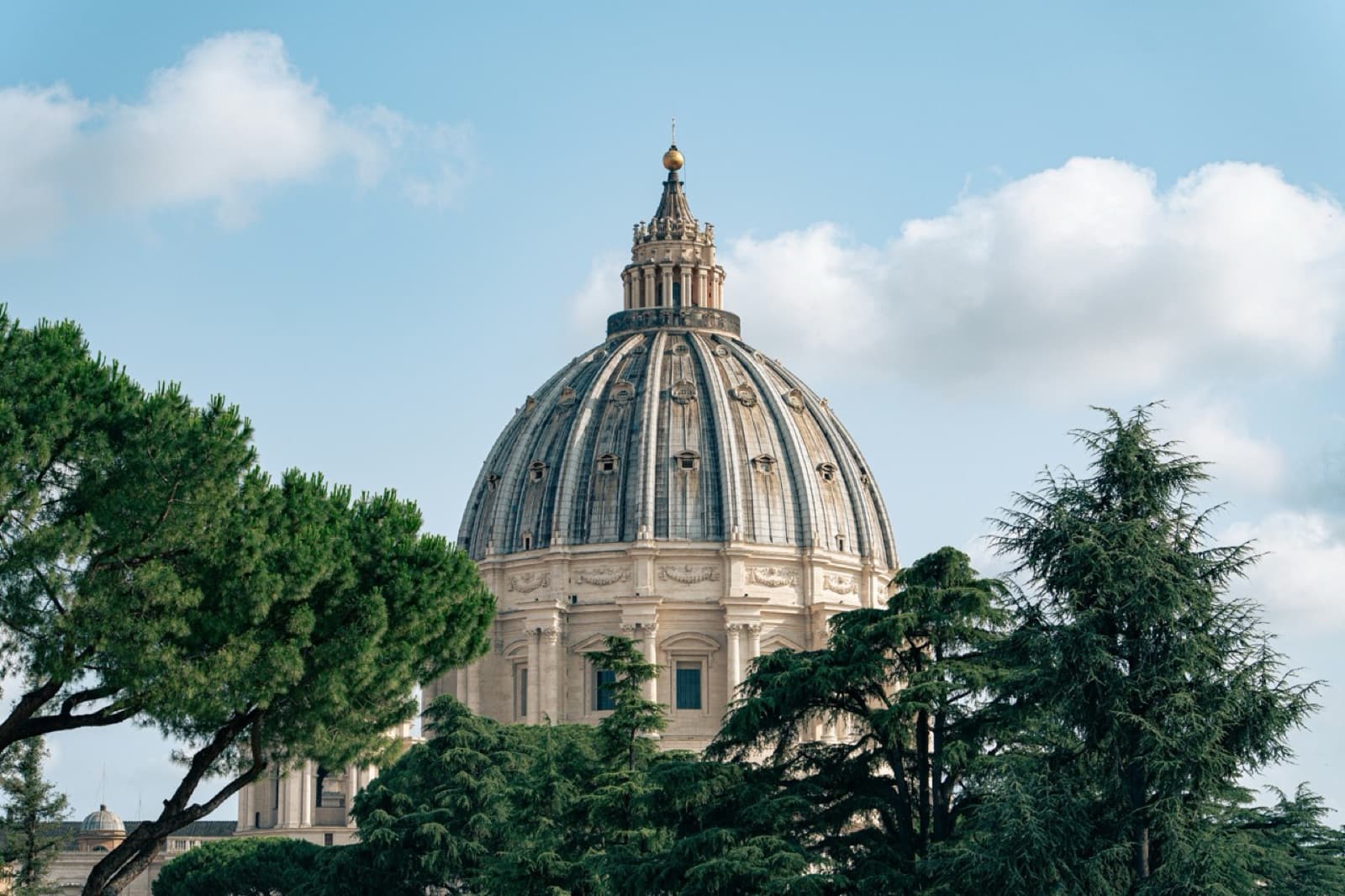
Before going in, look up at the dome. St. Peter’s Basilica isn’t just an enormous church: it’s the result of more than a hundred years of artistic rivalries and papal ambition, and it all begins with a tomb — that of the apostle Peter, by tradition buried right beneath after his martyrdom in Nero’s circus. The current basilica was started in 1506 under Bramante and consecrated in 1626 by Urban VIII. Michelangelo (the dome), Carlo Maderno (facade and nave) and Bernini (the baldachin and cathedra) all worked on it, among popes and architects, over more than a century.
Don’t-miss inside:
- Michelangelo’s Pietà (first chapel on the right as you enter) — he carved it at 24. Behind bulletproof glass since 1972, when a man attacked it with a hammer.
- Bernini’s Baldachin — the giant bronze canopy over the papal altar. The twisted (“Solomonic”) columns mark Peter’s tomb beneath.
- Bernini’s Chair at the back — the symbolic chair of Peter, held up by four Church Fathers.
- Vatican Grottoes (entry via a side staircase) — the papal crypt, holding several popes’ tombs. John Paul II’s is no longer here: in 2011 he was moved up to the Chapel of St. Sebastian inside the basilica.
Climbing the dome
Access from a side entrance. Two options:
- Stairs only — 551 steps. Cheaper.
- Lift + stairs — the lift goes up to the terrace (basilica roof), and from there 320 steps remain to reach the upper lantern.
The final section, inside the dome itself, is narrow and slanted — the ceiling curves with you. Not for the claustrophobic. But the view from the top is the best panorama of Rome you’ll get.
What to avoid
- Skip-the-line offers from people approaching you in the street. Price and access aren’t always guaranteed. For a guided tour, book through the official Museums office or a verified operator.
- Going on the last Sunday of the month to save money. It’s free but the queue is 3+ hours and the Sistine becomes unmanageable.
- Skipping the dome because “it’s a lot of stairs”. It’s the only thing that gives you perspective on the whole complex. Almost always worth it.
- Trying to do everything in one combined Rome tour. The Vatican needs its own energy. Mixing it with the Colosseum or Forum the same day = seeing everything half-heartedly.
Practical info
- Best time: November–February (shorter queues, manageable cold) or April–May. July and August: unbearable for heat and crowds.
- How to get there: metro line A, Ottaviano station (Museum entrance) or Cipro. On foot from Castel Sant'Angelo, 10 minutes.
- Official Vatican Museums tickets: museivaticani.va. Book at least 1 week ahead in high season.
- Papal audience (Wednesdays): free tickets via the Prefecture of the Papal Household, request at least 1 month ahead.
- Eating: avoid restaurants right next to the Museum entrance. Walk 5–10 minutes into Prati (Via Cola di Rienzo) — residential area with good pizza al taglio and local trattorias.
- Gear: covered clothing (shawl or sweater in summer), water bottle, walking shoes.